

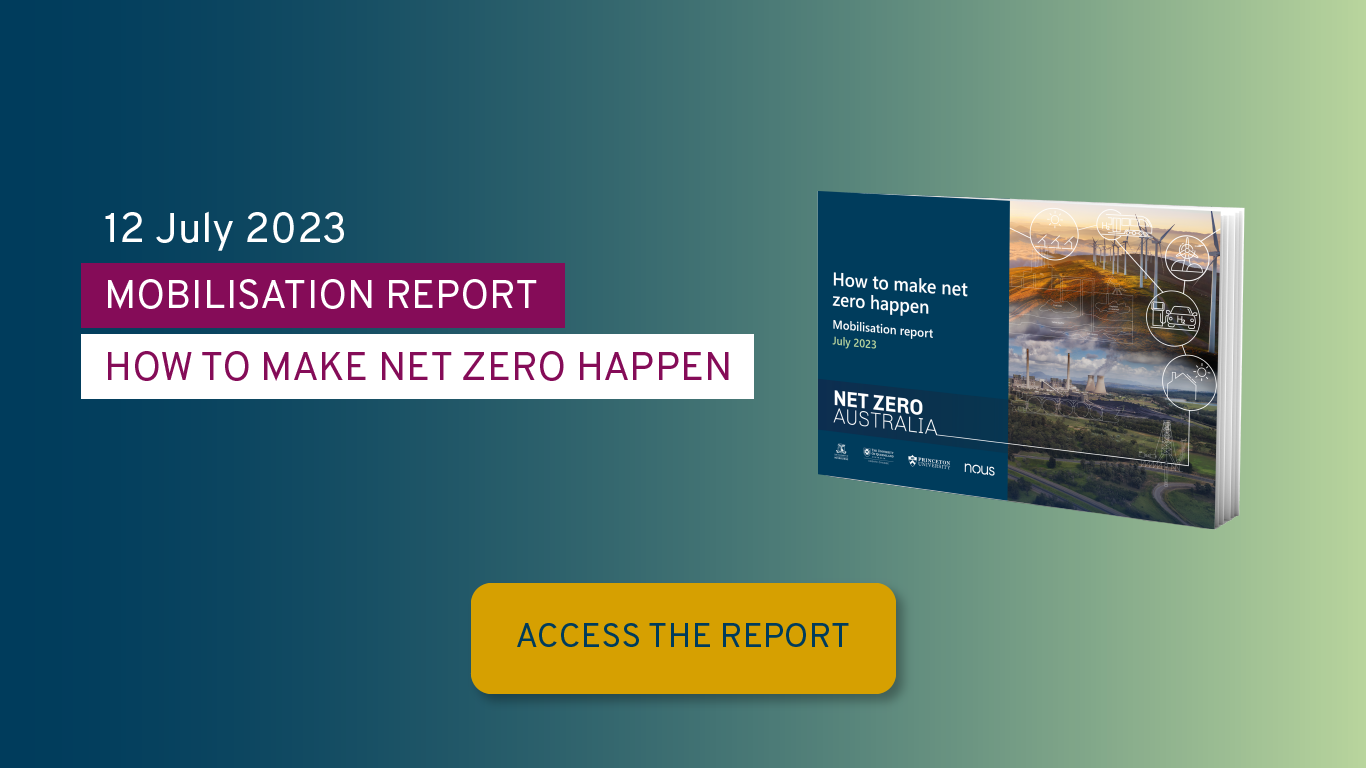
MOBILISATION REPORT RELEASED
The Mobilisation report was made public for the first time in July 2023.
The new report, How to make net zero happen, builds upon the final modelling results of the Net Zero Australia study and explores what governments, business and households should do to accelerate towards net zero.
About
Net Zero Australia
Net Zero Australia is a partnership between the University of Melbourne, the University of Queensland, Princeton University and international management consultancy Nous Group.
The study illustrates net zero pathways that reflect the boundaries of the Australian debate, for both our domestic and export emissions. Our purpose is to help individuals, communities, companies and governments appreciate:
- the scale, complexity and cost of the net zero task
- different ways in which the future could unfold
- how we all might contribute to the required changes
- how unintended consequences might be avoided and negative impacts reduced.
Net Zero Australia applies the approach pioneered by Princeton University’s Net Zero America study to Australia, and aims to be technology neutral, evidence driven and non-political.




About the research
The Net Zero Australia Study has:
- modelled pathways to decarbonise the energy, industrial and transport sectors whilst enhancing the natural land sink
- assessed the contribution that Australian exports can make to global decarbonisation whilst potentially offsetting the national and regional impacts caused by the decline in traditional fossil-fuelled industries
- incorporated local constraints that reflect the complexities, risks and uncertainties of the net zero transition
- ‘downscaled’ the modelled pathways to illustrate the build-out of assets and infrastructure with a high level of detail across sectors, land, and time
- identified and analysed socio-economic benefits, including pollution reduction and job creation
- understood the implications for capital mobilisation, incumbent industries, employment, and land use
- identified investment, infrastructure and innovation priorities that deliver technology deployment targets and create real options for rapid decarbonisation.
Why have another study?
The decarbonisation imperative is prompting commitments to reach net zero emissions by 2050 from governments and businesses around the world. However, there is a growing need for a comprehensive Australian study that can inform a study with greater detail and rigour to inform policy and business planning
The Net Zero America study brought unprecedented clarity and granularity to possible pathways to net zero emissions for the United States by mid-century. It is crucial to undertake a similar analysis of Australia’s pathways to a net-zero economy. Australian States and now the Federal Government, have pledged to reach net zero by 2050, and our national emissions policy is under increased scrutiny.
The Net Zero Australia study has helped allow Australia’s important and unique challenges to be addressed. A rigorous, objective, granular and transparent analysis of pathways to net zero can inform the planning for net zero emissions by 2050 by governments, businesses, non-profit organisations and communities.
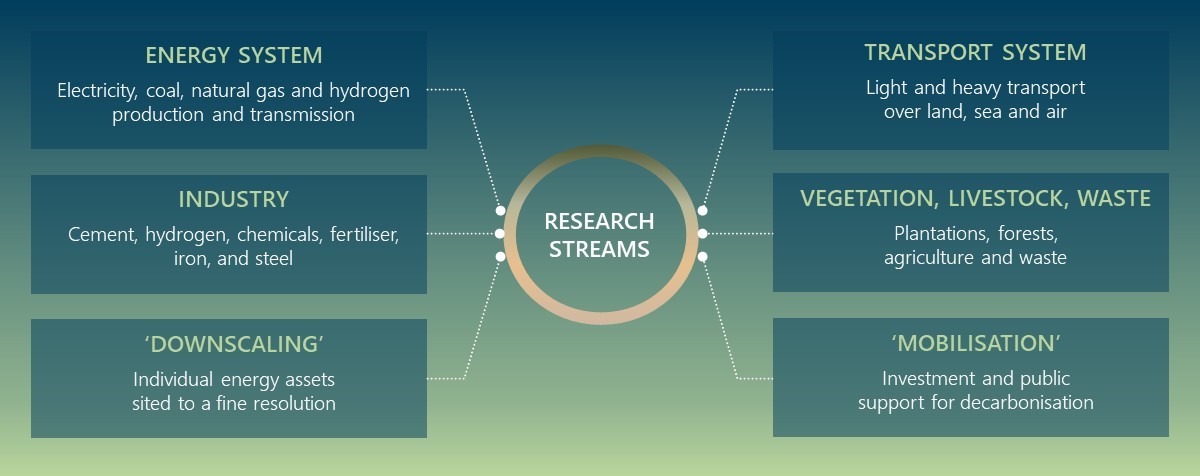
Our streams of research
Net Zero Australia breaks down the net zero challenge into six interrelated research streams. The research is being conducted collaboratively across partner institutions.


Sponsors
Net Zero Australia has been made possible by the generous support of the following organisations: